Imago's ultimate Vision
Where vision finds space.
The Big Picture
The Arts and creativity are difficult things for the present world view to grasp. We live in cultures that at the core are product and productivity driven with a heavy dose of consumerism. It is the pile of things that you produce and accumulate that defines who and what you are accordingly. Add to that the drive to be accepted, to act like, look like everyone else, and be what is defined as successful within that society, you have a perfect storm. Anything that thinks or reacts outside of those overly defined walls is viewed with suspicion and contempt. That leads to attitudes that reject intellectualism, creativity, and the arts as a whole as being to be rejected and/or tightly controlled and regulated. Only if these things can be used to shore up, promote, or be used to facilitate doctrine will they or can they be used. And only by those who the society deems right and proper in their collective minds.
However, that is not what it is all supposed to be.
From the world view of the Judeo/Christian understanding, we will put forth this idea.
God is calling us all back to the original blessing of our true identity. That identity is as the image and likeness of God as modeled in the life of Jesus. Not only did Jesus model it, but he demonstrated it in such a manner so that all who believe could replicate it. Jesus through his redemptive acts placed humanity’s image back to the original blessing found within Genesis 1 through 2:3.
26 Then God said, ‘Let us make humankind in our image, according to our likeness; and let them have dominion over the fish of the sea, and over the birds of the air, and over the cattle, and over all the wild animals of the earth, and over every creeping thing that creeps upon the earth.’
27 So God created humankind in his image, in the image of God he created them; male and female God created them.
The original word in Hebrew for what is translated as dominion is slightly off. The original word can be and is translated with the meaning of to come alongside. That is to help them be the best of what they can be not to rule over them as we understand the modern meaning of dominion to be.
That original blessing was that we were to act as co-creative agents commanded by God.
Creativity is not just a term for the narrow subject of the arts but is extended to bringing forth ideas and concepts from every form of human expression, experience and knowledge. That is to creatively help all of creation be the best it can be as it presently exists. Its value is not what it can produce in as much as it its value is that it exists. This is part of the focus of Imago Ministries.
Imago is the Latin root word of imagination and image. This represents the role of humanity as the image of God to be imaginative. Creating solutions for the problems of this world and adding more to its identity as a valuable piece of the whole of the cosmos. The arts/creativity are being called back to its place as a gift and talent to add value to existence.
In the bible, we are regaled with poetry, psalms, prose and accounts of grand artistic endeavors, dance, and music. We are given detailed description of temple design as given to David by God. The Bible is a grand recording of the creative effort of God and man’s response.
Why is it there is great detail as to how things are adorned in the temple? Why is the color of things in the temple so important? Why does music play an important role in things? Why is Jubal mentioned in the book of Genesis as the ancestor of all those who play the lyre and pipe in the beginning of civilization? Why is all this (and much more) detail about the arts recorded in the bible?
If we believe the bible is the witness to the word of God, we must logically draw this conclusion: It is recorded in the bible because it is of importance to God. Therefore, it must be very important for us
It is important to reestablish the place of the arts and creativity. Why you might ask? It is because we have entered into a new era of storytelling - one that is dependent upon visual and auditory stimulation to interact and understand the world around us. We can see this through the electronic campfires (TV/Computer) that glows blue through the night in our homes, and streams through the ports of our computers. We as a culture have rediscovered the story telling capability of the arts. The arts will be able to pass on the knowledge of the message that transcends just mere words as did the makers of medieval stained glass or the roving passion/mystery plays. We have moved from a printed page society to a visually titillated electronic society of moving images and sound.
The arts and creativity are gifts to us so that we can catch a glimpse of what it is like to be at the moment of creation.
We must also understand that creation is not a finite act. We must understand that this creative effort is still being played out today. This being said we as Christians must understand that we – being given the ability to come alongside of the earth and its creatures – share in the act of creation by adding to its already valuable existence. It is our birth rite to be creative individuals. This creativity is not just limited to the arts but to all aspects of life and is inclusive of all we do. A modern theologian, Francis Schaffer, puts it in his pamphlet Art & the Bible, states that “The Christian is the one whose imagination should fly beyond the stars.” Unfortunately this is not the case. We have lost this portion of the Image of God in whom we are created.
The arts and creativity are a part of the greater image of all of humanity. Give a child a plain stick that fell from a tree and you can unwrap the mysteries of the universe. In their hands it becomes a source of creativity and imagination; a magic wand, Excalibur, a rocket to the stars, a bow and arrow, a doll, a paint brush, a roaring camp fire, a magnificent piece of jewelry, a weapon, a crutch or a cure for the worst disease. The creative impulses of the child are limitless. They ask why not – the natural reaction to Paul’s proclamation of I can do all things through Christ who strengthens me.
Give an adult a stick and they quickly place it in a box or a bag to either be gotten rid of or processed into a commodity. It has limitations and boundaries. Dreams, possibilities, and hope are narrowed to artificial levels. It is this detachment from the creative that the adult shuts down the creative for the price of a coin.
The adult misses out on the joy of revealing in the creative. A part of this ministry is to help the adult recapture the creative and allow the child to keep developing creatively. Once you have recaptured the creative image you can see the potential and possibility of all things.
In helping all people realize their own creative potential they will more easily understand the need for the arts and creativity. The arts and creativity are there to edify, expand, challenge, initiate and foster the potential of all things. It is there to move things beyond the seven deadly words of “we have never done (or seen) it that way before.” It is there to move us to explore the concepts of why, why not and what for.
We hear that a picture is worth a thousand words yet and have a tendency to ignore the printed word as more than scribbling on a page. What we do not realize is that the printed word is also a graphic (artistic) symbol that others can see to understand. It is through visualization that we understand. Look at the printed word apple. For some people mind sees an actual apple not a series of letters. The symbol becomes the reality. The graphic reference or symbol must be tied to visual, auditory or tactile cue to be understood. If this were not true then why do we translate text (graphic symbols) to another set so that other cultures and languages can understand?
We must do it by example. There is a phrase in sociological circles that strongly echoes this and it goes - I cannot hear your words because your example is shouting in my ear.
We need to know how to train people to use their talents creatively as a reflection of their true and ultimate image. To this Imago dedicates itself; to seek out the arts and bring it into full view, to help people recapture their creative image, and to see that vision of a Center for Creativity is fully implemented and established
The Vision
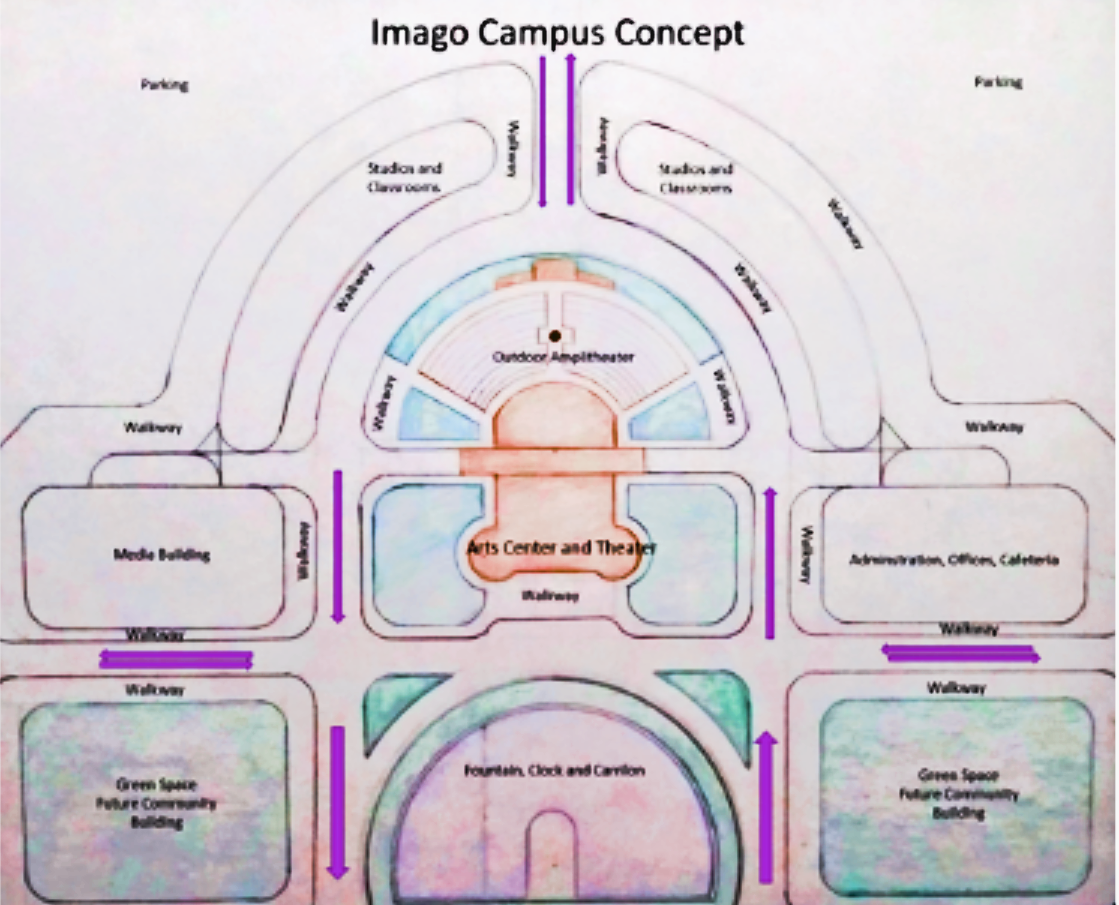
It is the vision of Imago to create a center for creativity; a campus where all the arts and creativity are used to help heal the body, mind, and spirit of all people, to train people in the arts as having a purpose of edification, and one that ultimately points the way. The vision consists of several campuses nationally and internationally. The plan for the site consists of a central building that is a theater complex where the arts can be offered up for the edification of all. A continuous offering of whom and what we are that is expressed as our daily efforts, work, and lives. In the center of the building is a solitary seat, one that is of the finest quality that roped off and marked reserved. Above it is a perpetual light. It is there as a reminder to whom we ultimately perform for. It is the audience of one.
The rest of the acreage consists of studios for the various arts. A broadcast building housing TV, radio, broadband streaming, and pod casts (or whatever the future holds.) Full teaching classrooms and housing for students and the artist in residence programs. There is a campground and motel for the retreat building and an outdoor theater complex. There is a contemplation labyrinth walk, sculpture gardens and nature trails. There are support buildings, full catering facilities and reception center. There are also rustic isolated cabins for use for personal retreats and extended periods of study.
The complex would have an operating organic farm and would lead with as many environmental alternative energy usages as possible. There are to be water features and undeveloped land all to reflect upon. It is to be an oasis of discovery. It is to be an ongoing creative reflection of creativity. It is an example of whole thought stewardship.
It is the objective of the ministry to be as self-supporting as possible so that the majority of funds raised go directly into people to participate in programs offered and outreach into the community.
There must also be programs that reach beyond the borders of just the Imago complex. Jesus established His ministry meeting people where they were in their need. Imago must also do this. It must be a clearing house to help the artistic communities with their unique needs. It must reach out to the community in general with creative approaches to problems of the community. In order to be trusted and accepted by the community, you have to invest in the community. You have to be able to provide the community with something to place their trust and hope in. There must be community-based buildings.
We must establish business links that can help the arts communities: insurance contacts of companies that specialize in life, health, business, and liability insurance; legal service contacts and kits to establish businesses and non-profits, contracts, leasing agreements, licensing and copy-write; offering books and materials of lists of how to start a business; and grants-where to look, apply and write for grants.
We also must establish arts outreach to the community at large. This means to provide art training and programs for the economically challenged communities; art, music, dance, and theater workshops; develop craft and art businesses for community economic development; community theaters; free traveling shows and presentations; arts talks; public worship events; community art shows and ministry fairs and community arts sponsorship.
This is the big picture.